|
поискавой системы для электроныых деталей |
|
|
поискавой системы для электроныых деталей |
|
ADP1053ACPZ-R7 датащи(PDF) 36 Page - Analog Devices |
|
|
|||||||||||||||||||||||||||||
ADP1053ACPZ-R7 датащи(HTML) 36 Page - Analog Devices |
|
|
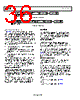
36 / 84 page  ADP1053 Data Sheet Rev. A | Page 36 of 84 A A SA A W 7-BIT SLAVE ADDRESS COMMAND CODE P A BYTE COUNT = N DATA BYTE 1 DATA BYTE N MASTER TO SLAVE SLAVE TO MASTER Figure 36. Block Write Protocol Sr A 7-BIT SLAVE ADDRESS A R A SA W 7-BIT SLAVE ADDRESS COMMAND CODE A BYTE COUNT = N DATA BYTE 1 MASTER TO SLAVE SLAVE TO MASTER P A DATA BYTE N Figure 37. Block Read Protocol Clock Generation and Stretching The ADP1053 is always a PMBus slave device in the overall system; therefore, the device never needs to generate the clock, which is done by the master device in the system. However, the PMBus slave device is capable of clock stretching to put the master in a wait state. By stretching the SCL signal during the low period, the slave device communicates to the master device that it is not ready and that the master device must wait. Conditions where the PMBus slave device stretches the SCL line low include the following: • The master device is transmitting at a higher baud rate than the slave device. • The receive buffer of the slave device is full and must be read before continuing. This prevents a data overflow condition. • The slave device is not ready to send data that the master has requested. Note that the slave device can stretch the SCL line only during the low period. Also, whereas the I2C specification allows indefinite stretching of the SCL line, the PMBus specification limits the maximum time that the SCL line can be stretched, or held low, to 25 ms, after which the device must release the communication lines and reset its state machine. GENERAL CALL SUPPORT The PMBus slave is capable of decoding and acknowledging a general call address. The PMBus device responds to both its own address and the general call address (0x00). The general call address enables all devices on the PMBus to be written to simultaneously. Note that all PMBus commands must start with the slave address with the R/W bit cleared (set to 0), followed by the command code. This is also true when using the general call address to communicate with the PMBus slave device. FAST MODE Fast mode (400 kHz) uses essentially the same mechanics as the standard mode of operation; the electrical specifications and timing are most affected. The PMBus slave is capable of communicating with a master device operating in standard mode (100 kHz) or fast mode. FAULT CONDITIONS The PMBus protocol provides a comprehensive set of fault conditions that must be monitored and reported. These fault conditions can be grouped into two major categories: commu- nication faults and monitoring faults. Communication faults are error conditions associated with the data transfer mechanism of the PMBus protocol. Monitoring faults are error conditions associated with the operation of the ADP1053, such as output overvoltage protection. These fault conditions are described in the Power Monitoring and Flags section. TIMEOUT CONDITIONS The SMBus specification, Version 2.0, includes three clock stretching specifications related to timeout conditions. TTIMEOUT A timeout condition occurs if any single SCL clock pulse is held low for longer than the tTIMEOUT of 25 ms (min). Upon detecting the timeout condition, the PMBus slave device has 10 ms to abort the transfer, release the bus lines, and be ready to accept a new start condition. The device initiating the timeout is required to hold the SCL clock line low for at least tTIMEOUT MAX = 35 ms, guaranteeing that the slave device is given enough time to reset its communication protocol. TLOW:SEXT This condition is not supported by the ADP1053. TLOW:MEXT This condition is not supported by the ADP1053. |
|
ссылки URL |
| Вашему бизинису помогли Аллдатащит? [ DONATE ] |
Что такое Аллдатащит | реклама | контакт | Конфиденциальность | Ссылка на техническое описание | обмен ссыками | поиск по производителю All Rights Reserved©Alldatasheet.com |
| Russian : Alldatasheetru.com | Korean : Alldatasheet.co.kr | Spanish : Alldatasheet.es | French : Alldatasheet.fr | Italian : Alldatasheetit.com Portuguese : Alldatasheetpt.com | Polish : Alldatasheet.pl | Vietnamese : Alldatasheet.vn Indian : Alldatasheet.in | Mexican : Alldatasheet.com.mx | British : Alldatasheet.co.uk | New Zealand : Alldatasheet.co.nz |
|
Family Site : ic2ic.com |
icmetro.com |
 Russian ▼
 English
 Chinese
 German
 Japanese
 Russian
 Korean
 Spanish
 French
 Italian
 Portuguese
 Polish
 Vietnamese
 Indian
 Mexican
 British
 New Zealand