|
поискавой системы для электроныых деталей |
|
|
поискавой системы для электроныых деталей |
|
ADP1055ACPZ-R7 датащи(PDF) 39 Page - Analog Devices |
|
|
|||||||||||||||||||||||||||||
ADP1055ACPZ-R7 датащи(HTML) 39 Page - Analog Devices |
|
|
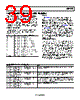
39 / 140 page  Data Sheet ADP1055 Rev. A | Page 39 of 140 FAULT RESPONSES AND STATE MACHINE MECHANICS When a potentially abnormal condition occurs in the power supply that is regulated by the ADP1055, a flag is asserted and the system waits for a programmed debounce time. If the flag is continuously asserted until the end of the debounce time, it is latched as a fault. The fault is then processed according to the programmed fault response setting. The fault is cleared only when the flag condition is removed. The debounce circuitry is reset when the flag condition is removed; until then the fault remains set. PRIORITY OF FAULTS The response to each fault is configurable and is based on a priority level (see Table 7). A higher number indicates a higher priority. Table 7. Priority of Faults Priority Fault and Configured Fault Response 12 (highest) Voltage fault: disable output 11 Voltage fault: shutdown with no retry 10 Current fault: shutdown with no retry 9 Voltage fault: shutdown with limited retry 8 Current fault: shutdown with limited retry 7 Voltage fault: shutdown with unlimited retry 6 Current fault: shutdown with unlimited retry 5 Voltage fault: wait delay and shutdown with limited or unlimited retry 4 Current fault: constant current with wait delay 3 Current fault: constant current without tripping VOUT_LV 2 Current fault: constant current mode 1 (lowest) Voltage fault: ignore fault FLAGS The ADP1055 has an extensive set of flags that are set when certain limits, conditions, and thresholds are exceeded. The response to these flags is individually programmable. Flags can be ignored or used to trigger actions such as turning off certain PWM outputs or entering constant current mode. Flags can also be used to turn off the power supply. The ADP1055 can be pro- grammed to respond when these flags are reset. The ADP1055 also has a set of latched fault registers (Register 0xFE8C to Register 0xFE93). The latched fault registers have the same flags as the PMBus STATUS_x commands (Register 0x7A to Register 0x80), but the flags in the latched registers remain set so that intermittent faults can be detected. The CLEAR_FAULTS command (Register 0x03) clears the latched fault registers and resets all the flags. FIRST FAULT ID (FFID) The first fault ID (FFID) information is used to capture the first fault that caused the system to shut down. Register 0xFE95 contains the ID of the first fault that caused the system to shut down. Faults captured in the first fault ID register have configured actions of shutdown immediate, shutdown with retries, and disable PWM outputs with watchdog timeout. The contents of Register 0xFE95 cannot be overwritten unless the information is first cleared. The FFID can be cleared by the CLEAR_FAULTS command (Register 0x03), by a power cycle of the device, or by a PSON signal using Register 0x01, Register 0x02, or both. If the black box feature is enabled, the FFID can also be cleared when the information is saved into the black box. Table 8. Example First Fault ID Scenarios Test Setup Condition Result OCP has retry/delay of 100 ms with Priority 10, debounce = 0. OVP has retry/delay of 200 ms with Priority 9, debounce = 0. OCP occurs at t = 0. OVP occurs at t = 10 ms. OCP fault is processed due to smaller debounce time (no retry time), as well as higher priority. OCP has retry/delay of 100 ms with Priority 10, debounce = 0. OVP has retry/delay of 0 ms with Priority 11, debounce = 0. OCP occurs at t = 0. OVP occurs at t = 10 ms. OCP fault is processed at t = 0; device waits 100 ms before action is taken. OCP fault is replaced by OVP, and then OVP fault is processed at t = 10 ms due to higher priority even though retry delay is larger. OCP has retry/delay of 100 ms with Priority 8, debounce = 5 ms. OVP has retry/delay of 200 ms with Priority 9, debounce = 100 ms. OCP occurs at t = 50 ms. OVP occurs at t = 0. OVP is registered as a fault at t = 100 ms. OCP is registered as a fault at t = 55 ms. However, at t = 100 ms, OCP loses priority and OVP is processed due to higher priority. Exception: If delay of OCP was smaller (for example, 5 ms), then OCP action is processed. OCP has retry/delay of 100 ms with Priority 8, debounce = 0. OVP has retry/delay of 200 ms with Priority 7, debounce = 0. OCP occurs at t = 0. OVP occurs at t = 0. OCP fault is processed due to higher priority. |
|
ссылки URL |
| Вашему бизинису помогли Аллдатащит? [ DONATE ] |
Что такое Аллдатащит | реклама | контакт | Конфиденциальность | Ссылка на техническое описание | обмен ссыками | поиск по производителю All Rights Reserved©Alldatasheet.com |
| Russian : Alldatasheetru.com | Korean : Alldatasheet.co.kr | Spanish : Alldatasheet.es | French : Alldatasheet.fr | Italian : Alldatasheetit.com Portuguese : Alldatasheetpt.com | Polish : Alldatasheet.pl | Vietnamese : Alldatasheet.vn Indian : Alldatasheet.in | Mexican : Alldatasheet.com.mx | British : Alldatasheet.co.uk | New Zealand : Alldatasheet.co.nz |
|
Family Site : ic2ic.com |
icmetro.com |
 Russian ▼
 English
 Chinese
 German
 Japanese
 Russian
 Korean
 Spanish
 French
 Italian
 Portuguese
 Polish
 Vietnamese
 Indian
 Mexican
 British
 New Zealand