 |
поискавой системы для электроныых деталей |
|
|
поискавой системы для электроныых деталей |
|
The question interval is too short.
Please try again in a few seconds.

Hello, Please ask a question about S25SC6M Datasheet
# Example questions:
➢ How does the repetitive surge reverse power (prrsm) change as the junction temperature (tj) increases?
➢ What is the approximate peak surge forward current (if) for a single cycle?
➢ According to the diagrams, what do irp and vrp represent?
| Part No. | S25SC6M |
| Manufacturer | SHINDENGEN |
| Size | 539 Kbytes |
| Pages | 10 pages |
| Description | Schottky Rectifiers (SBD) (60V 25A) |


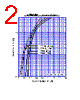

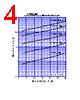
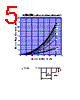
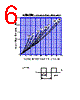


## Summary of the Provided Datasheets for the Schottky Diode
This document contains datasheets for a Schottky diode, detailing its electrical characteristics and performance under various conditions. Here's a breakdown of the key takeaways:
1. Key Electrical Characteristics (Typical):
️· Forward Voltage: Relatively low, typical of Schottky diodes, contributing to efficiency.
️· Reverse Voltage: Rated for a specific reverse voltage.
️· Current Rating: Specified maximum average forward current and peak pulse current.
️· Power Dissipation: Indicates how much power the diode can handle without exceeding its temperature limits.
2. Performance Graphs & Derating Curves:
️· Forward Power Dissipation vs. Forward Current: Shows the relationship between power dissipated and current, crucial for thermal management.
️· Reverse Leakage Current vs. Reverse Voltage: Illustrates the increase in leakage current with higher reverse voltage.
️· Peak Surge Forward Capability: Shows the maximum peak current the diode can handle for a single pulse or a limited number of cycles.
️· Derating Curve (Case Temperature): Demonstrates how the forward current rating decreases as the case temperature rises. This is vital for ensuring reliable operation.
️· Reverse Power Dissipation vs. Junction Temperature: Shows how the Reverse Power Dissipation decreases as Junction Temperature increases.
️· Repetitive Surge Reverse Power Derating Curve: Illustrates the relation between Reverse Power dissipation, Reverse voltage and Junction Temperature.
️· Pulsed Width vs Reverse Power: Illustrates the relation between Pulsed Width and Reverse Power.
3. Thermal Considerations:
️· Thermal Resistance: Provides values for junction-to-case and junction-to-ambient thermal resistance.
️· Temperature Derating: Highlights how the diode's performance is affected by temperature. Proper heat sinking is essential.
4. Important Parameters & Concepts:
️· Schottky Diode Characteristics: Schottky diodes are known for their low forward voltage drop and fast switching speed. This makes them suitable for applications like switching power supplies, voltage clamping, and protection circuits.
️· Pulsed vs. Continuous Current: The diode can handle higher current pulses for short durations than it can sustain continuously.
️· Repetitive Surge: The diode can withstand a limited number of surge pulses, but the number and amplitude of these pulses must be within the specified limits.
In essence, these datasheets provide the information necessary for engineers to select and use this Schottky diode effectively in their designs, taking into account its electrical characteristics, thermal limits, and the specific application requirements.
## Summary of the Provided Datasheets for the Schottky Diode
This document contains datasheets for a Schottky diode, detailing its electrical characteristics and performance under various conditions. Here's a breakdown of the key takeaways:
1. Key Electrical Characteristics (Typical):
️· Forward Voltage: Relatively low, typical of Schottky diodes, contributing to efficiency.
️· Reverse Voltage: Rated for a specific reverse voltage.
️· Current Rating: Specified maximum average forward current and peak pulse current.
️· Power Dissipation: Indicates how much power the diode can handle without exceeding its temperature limits.
2. Performance Graphs & Derating Curves:
️· Forward Power Dissipation vs. Forward Current: Shows the relationship between power dissipated and current, crucial for thermal management.
️· Reverse Leakage Current vs. Reverse Voltage: Illustrates the increase in leakage current with higher reverse voltage.
️· Peak Surge Forward Capability: Shows the maximum peak current the diode can handle for a single pulse or a limited number of cycles.
️· Derating Curve (Case Temperature): Demonstrates how the forward current rating decreases as the case temperature rises. This is vital for ensuring reliable operation.
️· Reverse Power Dissipation vs. Junction Temperature: Shows how the Reverse Power Dissipation decreases as Junction Temperature increases.
️· Repetitive Surge Reverse Power Derating Curve: Illustrates the relation between Reverse Power dissipation, Reverse voltage and Junction Temperature.
️· Pulsed Width vs Reverse Power: Illustrates the relation between Pulsed Width and Reverse Power.
3. Thermal Considerations:
️· Thermal Resistance: Provides values for junction-to-case and junction-to-ambient thermal resistance.
️· Temperature Derating: Highlights how the diode's performance is affected by temperature. Proper heat sinking is essential.
4. Important Parameters & Concepts:
️· Schottky Diode Characteristics: Schottky diodes are known for their low forward voltage drop and fast switching speed. This makes them suitable for applications like switching power supplies, voltage clamping, and protection circuits.
️· Pulsed vs. Continuous Current: The diode can handle higher current pulses for short durations than it can sustain continuously.
️· Repetitive Surge: The diode can withstand a limited number of surge pulses, but the number and amplitude of these pulses must be within the specified limits.
In essence, these datasheets provide the information necessary for engineers to select and use this Schottky diode effectively in their designs, taking into account its electrical characteristics, thermal limits, and the specific application requirements.
| Part No. | S25SC6M |
| Manufacturer | SHINDENGEN |
| Size | 539 Kbytes |
| Pages | 10 pages |
| Description | Schottky Rectifiers (SBD) (60V 25A) |
| Вашему бизинису помогли Аллдатащит? [ DONATE ] |
Что такое Аллдатащит | реклама | контакт | Конфиденциальность | Ссылка на техническое описание | обмен ссыками | поиск по производителю All Rights Reserved©Alldatasheet.com |
| Russian : Alldatasheetru.com | Korean : Alldatasheet.co.kr | Spanish : Alldatasheet.es | French : Alldatasheet.fr | Italian : Alldatasheetit.com Portuguese : Alldatasheetpt.com | Polish : Alldatasheet.pl | Vietnamese : Alldatasheet.vn Indian : Alldatasheet.in | Mexican : Alldatasheet.com.mx | British : Alldatasheet.co.uk | New Zealand : Alldatasheet.co.nz |
|
Family Site : ic2ic.com |
icmetro.com |
 Russian ▼
  English
 Chinese
 German
 Japanese
 Korean
 Spanish
 French
 Italian
 Portuguese
 Polish
 Vietnamese
 Indian
 Mexican
 British
 New Zealand