 |
поискавой системы для электроныых деталей |
|
|
поискавой системы для электроныых деталей |
|
The question interval is too short.
Please try again in a few seconds.

Hello, Please ask a question about FT232BQ Datasheet
# Example questions:
➢ What is the primary function of the 'rstout#' pin?
➢ The ft232bq supports both qfn32 and lqfp packages. what does rohs compliance signify in relation to these packages?
➢ What is the recommended decoupling capacitor value for the '3v3out' pin, and what is its purpose?
| Part No. | FT232BQ |
| Manufacturer | FTDI |
| Size | 557 Kbytes |
| Pages | 26 pages |
| Description | USB UART ( USB - Serial) I.C. |








1. Overview & Function:
️· The FT232BQ is a USB to Serial UART (Universal Asynchronous Receiver/Transmitter) bridge. It allows a computer's USB port to communicate with serial devices like RS232, RS485, or other UART-based equipment.
️· It's a bridge, meaning it translates data between the USB protocol and the serial communication protocol.
2. Power & Voltage:
️· VCC: 4.35V to 5.25V - Core supply voltage.
️· VCCIO: 3.0V to 5.25V - UART interface supply. Critical! Use 3.3V if interfacing with 3.3V UART logic.
️· 3V3OUT: 3.3V output from a built-in regulator. Must be decoupled to ground with a 33nF ceramic capacitor. Can supply a small amount of current (<= 5mA) to external devices.
️· AVCC & AGND: Analog supplies for the clock multiplier.
3. USB Interface:
️· USBDP: USB Data Plus – Requires a 1.5k pull-up resistor to 3V3OUT or RSTOUT#.
️· USBDM: USB Data Minus.
️· The chip is designed to comply with the European Union RoHS directive (lead-free).
4. Serial Interface (UART):
️· TXDEN: Enables RS485 transmit data.
️· RTS#: Request to Send – Handshake signal.
️· CTS#: Clear to Send – Handshake signal.
️· DTR#: Data Terminal Ready – Handshake signal.
️· DSR#: Data Set Ready – Handshake signal.
️· DCD#: Data Carrier Detect – Handshake signal.
️· RI#: Ring Indicator - Can be used with EEPROM configuration for PC host resume from suspend.
5. EEPROM Interface:
️· EECS: Chip Select - Tri-state during reset. 10k pull down resistor on this pin changes the USB product ID.
️· EESK: Clock signal to EEPROM. Tri-state during reset.
️· EEDATA: Data I/O – Requires external resistors. Tri-state during reset.
6. Control Signals:
️· SLEEP#: Goes low during USB suspend, used to power down external logic.
️· PWREN#: Goes low after configuration, high during suspend. Used to control external logic.
️· RESET#: External reset input.
️· RSTOUT#: Reset output.
️· TXLED# & RXLED#: LED drive outputs for transmit and receive indication.
️· XTIN & XTOUT: Crystal oscillator pins - XTOUT stops oscillating during USB suspend.
7. Package:
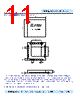
️· QFN-32 (leadless package) - 5mm x 1mm
️· Also available in LQFP.
Key Takeaways & Considerations:
️· Decoupling Capacitor: Crucial to place a 33nF ceramic capacitor close to the 3V3OUT pin.
️· VCCIO Voltage: Pay careful attention to the VCCIO voltage level based on the logic it's interfacing with.
️· External Resistors: Several pins require external resistors for proper EEPROM interface and data signaling.
️· USB Suspend: Be aware of the signals that change state during USB suspend (SLEEP#, XTOUT).
️· EEPROM Configuration: The EEPROM can be used to configure the chip's behavior and change the USB product ID.
This summary should help you understand the core functionality and important considerations for using the FT232BQ. Do you have any specific questions about a particular aspect of this device?
1. Overview & Function:
️· The FT232BQ is a USB to Serial UART (Universal Asynchronous Receiver/Transmitter) bridge. It allows a computer's USB port to communicate with serial devices like RS232, RS485, or other UART-based equipment.
️· It's a bridge, meaning it translates data between the USB protocol and the serial communication protocol.
2. Power & Voltage:
️· VCC: 4.35V to 5.25V - Core supply voltage.
️· VCCIO: 3.0V to 5.25V - UART interface supply. Critical! Use 3.3V if interfacing with 3.3V UART logic.
️· 3V3OUT: 3.3V output from a built-in regulator. Must be decoupled to ground with a 33nF ceramic capacitor. Can supply a small amount of current (<= 5mA) to external devices.
️· AVCC & AGND: Analog supplies for the clock multiplier.
3. USB Interface:
️· USBDP: USB Data Plus – Requires a 1.5k pull-up resistor to 3V3OUT or RSTOUT#.
️· USBDM: USB Data Minus.
️· The chip is designed to comply with the European Union RoHS directive (lead-free).
4. Serial Interface (UART):
️· TXDEN: Enables RS485 transmit data.
️· RTS#: Request to Send – Handshake signal.
️· CTS#: Clear to Send – Handshake signal.
️· DTR#: Data Terminal Ready – Handshake signal.
️· DSR#: Data Set Ready – Handshake signal.
️· DCD#: Data Carrier Detect – Handshake signal.
️· RI#: Ring Indicator - Can be used with EEPROM configuration for PC host resume from suspend.
5. EEPROM Interface:
️· EECS: Chip Select - Tri-state during reset. 10k pull down resistor on this pin changes the USB product ID.
️· EESK: Clock signal to EEPROM. Tri-state during reset.
️· EEDATA: Data I/O – Requires external resistors. Tri-state during reset.
6. Control Signals:
️· SLEEP#: Goes low during USB suspend, used to power down external logic.
️· PWREN#: Goes low after configuration, high during suspend. Used to control external logic.
️· RESET#: External reset input.
️· RSTOUT#: Reset output.
️· TXLED# & RXLED#: LED drive outputs for transmit and receive indication.
️· XTIN & XTOUT: Crystal oscillator pins - XTOUT stops oscillating during USB suspend.
7. Package:
️· QFN-32 (leadless package) - 5mm x 1mm
️· Also available in LQFP.
Key Takeaways & Considerations:
️· Decoupling Capacitor: Crucial to place a 33nF ceramic capacitor close to the 3V3OUT pin.
️· VCCIO Voltage: Pay careful attention to the VCCIO voltage level based on the logic it's interfacing with.
️· External Resistors: Several pins require external resistors for proper EEPROM interface and data signaling.
️· USB Suspend: Be aware of the signals that change state during USB suspend (SLEEP#, XTOUT).
️· EEPROM Configuration: The EEPROM can be used to configure the chip's behavior and change the USB product ID.
This summary should help you understand the core functionality and important considerations for using the FT232BQ. Do you have any specific questions about a particular aspect of this device?
| Part No. | FT232BQ |
| Manufacturer | FTDI |
| Size | 557 Kbytes |
| Pages | 26 pages |
| Description | USB UART ( USB - Serial) I.C. |
| Вашему бизинису помогли Аллдатащит? [ DONATE ] |
Что такое Аллдатащит | реклама | контакт | Конфиденциальность | Ссылка на техническое описание | обмен ссыками | поиск по производителю All Rights Reserved©Alldatasheet.com |
| Russian : Alldatasheetru.com | Korean : Alldatasheet.co.kr | Spanish : Alldatasheet.es | French : Alldatasheet.fr | Italian : Alldatasheetit.com Portuguese : Alldatasheetpt.com | Polish : Alldatasheet.pl | Vietnamese : Alldatasheet.vn Indian : Alldatasheet.in | Mexican : Alldatasheet.com.mx | British : Alldatasheet.co.uk | New Zealand : Alldatasheet.co.nz |
|
Family Site : ic2ic.com |
icmetro.com |
 Russian ▼
  English
 Chinese
 German
 Japanese
 Korean
 Spanish
 French
 Italian
 Portuguese
 Polish
 Vietnamese
 Indian
 Mexican
 British
 New Zealand